
The Complete Guide to Guitar Humidity
Every guitar player knows the frustration: one day your guitar plays perfectly, and the next, it’s buzzing, the action feels “off,” and the fret ends are sharp to the touch. The culprit? Relative humidity—or RH for short. Whether you own a vintage acoustic or a modern electric, the wood in your instrument is constantly interacting with its environment. When humidity levels shift, the wood moves, altering everything from neck relief and action to structural integrity.
From painful “fret sprout” to devastating top cracks, humidity damage is the leading cause of expensive, yet avoidable, repairs. You may not realize it, but how and where you store your gear is just as critical as the strings, pickups, and hardware you choose. While environmental control may seem daunting, it’s actually a simple, repeatable system.
This guide breaks down the science of the Safe Zone and provides a roadmap to keeping your instruments playing and sounding great for a lifetime. All the tips in this guide can be used on any stringed instrument, including acoustic and electric guitars, basses, ukuleles, mandolins, and more.
Table of Contents
Section One: Understanding the Environment
What exactly is "Relative Humidity" (RH) and how does it affect my guitar?
Relative Humidity is the amount of water vapor present in the air compared to the maximum amount the air can hold at a specific temperature. Put simply: it’s a measurement of how much moisture is in the air around you. The wood in your guitar, especially thin, unfinished sections like fingerboards and inside acoustic guitars, requires a specific amount of moisture to remain stable yet flexible.
Think of it this way: when a room is dry and your skin feels tight or rough, your guitar is feeling the same. Most stringed instruments are made of wood, which is “hygroscopic.” This means wood acts like a sponge, constantly absorbing and releasing moisture to stay in equilibrium with its environment.
When the air is too dry (low humidity), the wood cells shrink and contract. Conversely, when the air is too wet (high humidity), those same cells expand. This constant “breathing” is what leads to setup issues, playability problems, and eventually, structural damage.
What happens to my guitar if my relative humidity is too low (Below 40%)?
When humidity levels drop too low, your instrument begins to lose its essential moisture, causing the wood to shrink and contract. This can cause permanent damage if not addressed quickly.
- Cracked tonewoods: In an acoustic guitar, shrinking wood creates immense internal tension as it pulls against the rigid, glued-in internal braces and pickguard. Because the wood is restricted, it eventually fails and splits, resulting in structural cracks along the grainlines of the top, back, or sides.
- Sunken top and neck joint failure: Low humidity is particularly detrimental near the neck joint. As the wood dries out, the neck-to-body connection can lose its structural integrity, shifting the neck angle. In extreme cases, the wood around the soundhole can even “sink” or crush inward, resulting in unplayable action.
- Fret Sprout: This occurs on both electric and acoustic guitars when the fingerboard wood shrinks, but the metal frets do not. The result is sharp fret ends that protrude past the edge of the neck, making the instrument uncomfortable—and sometimes painful—to play. For a deep dive into diagnosing and repairing sharp fret ends, see The Complete Guide to Fixing Guitar and Bass Fret Sprout.
- Finish checking: Dry conditions can cause the finish (especially nitrocellulose lacquer) to lose its elasticity. As the wood underneath moves and the finish becomes brittle, it develops “checking”—a series of fine, spider-web cracks across the surface of the instrument.
- Neck Instability: As a long, thin piece of wood under constant string tension, the neck is highly sensitive to moisture, changing the relief and resulting in string buzz. If these shifts are left unmonitored, the neck can develop a permanent twist, “S-curve,” or “wood memory” that standard truss rod adjustments cannot fix, requiring costly professional repair.
What happens to my guitar if my relative humidity is too high (Above 55%)?
After years of collaborating with world-class builders and elite repair techs, we’ve defined the Safe Zone for stringed instruments. To keep your guitar playing and sounding its best, you should maintain an environment of 40%–55% relative humidity and a temperature between 70°F and 78°F (21°C to 26°C).
A good rule of thumb: if you are comfortable in the room, your guitar likely is, too. However, comfort is subjective—precision is not. This is why your instrument should always be stored in an area where the humidity is being actively monitored with a high-quality digital hygrometer. Staying within the Safe Zone prevents the wood from moving, protects the glue joints, and ensures your setup stays dialed in year-round.
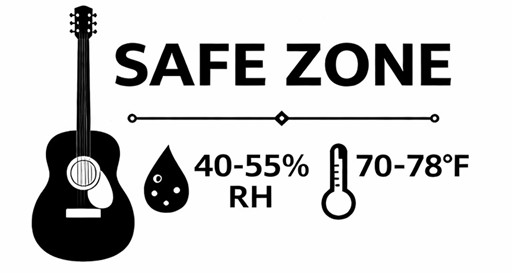
Why do guitars need to stay in a Safe Zone to be playable?
Maintaining consistent humidity and temperature is the #1 rule for keeping your instrument healthy, stable, and playing great. When stored within the Safe Zone, the wood moves minimally, remaining as close to its original factory specifications as possible.
- Luthier-approved stability: Master builders and luthiers construct instruments in highly controlled environments (typically 40%–55% RH). By mirroring that environment at home, you ensure your guitar plays and sounds exactly as the builder intended.
- Precision setups: Your string action and neck relief depend on the wood’s moisture content. Staying in the Safe Zone prevents the “shifting” that leads to fret buzz or high, difficult action.
- Preventing permanent damage: Consistency is your best defense against catastrophic failure. It prevents the internal tension that leads to cracked tops, loose braces, warped necks, and painful fret sprout.
The best repair is the one you never have to make. Keeping your gear in the Safe Zone isn’t just about maintenance—it’s about protecting your instrument for years to come.
Is humidity only a problem for acoustic guitars, or do electric guitars and basses need care too?
While acoustic guitars are more fragile because they are hollow and constructed from thinner tonewoods, electric guitars and basses are equally susceptible to environmental damage. Because their necks are made of wood, they are still “living” components that react to the air.
- Neck stability: On any electric guitar or bass, low humidity can cause the neck to bow or twist, while high humidity can cause it to swell. This leads to inconsistent action and annoying fret buzz.
- Fret sprout: This is a common and painful issue for both electric and acoustic players in dry climates. When the fingerboard shrinks, the metal frets stay the same size, leaving sharp ends poking out that can literally cut your hand while playing.
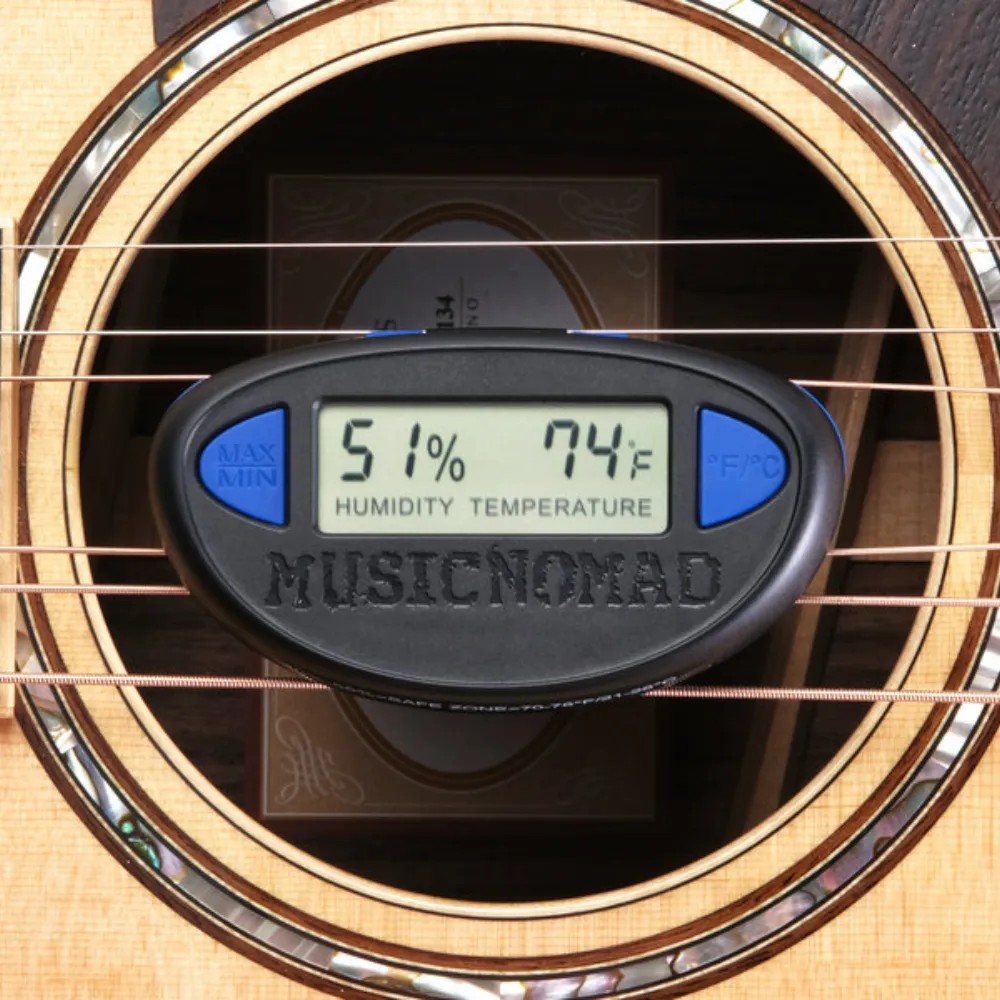
Because acoustic guitars are more susceptible to humidity change, it’s best to use a hygrometer that measures the humidity in the case with the guitar, or most accurately in the soundhole, like our MusicNomad Hone. You can also combine both a hygrometer and humidifier with our Humitar ONE to monitor and regulate your guitar’s humidity with one tool.
-
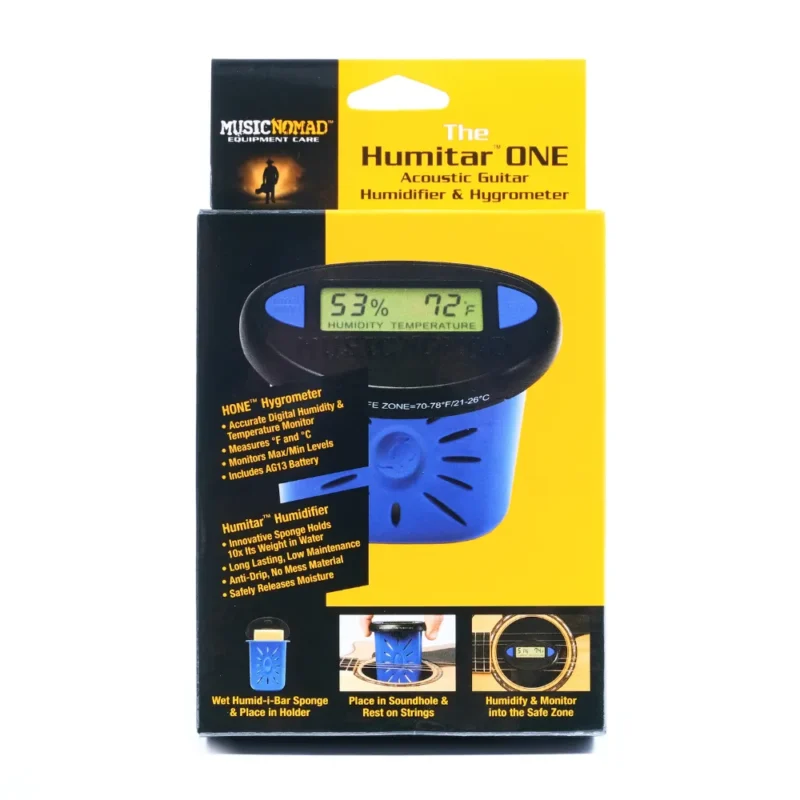
The Humitar ONE – Acoustic Guitar Humidifier & Hygrometer
MN311$29.99Rated 5.00 out of 5(4) -
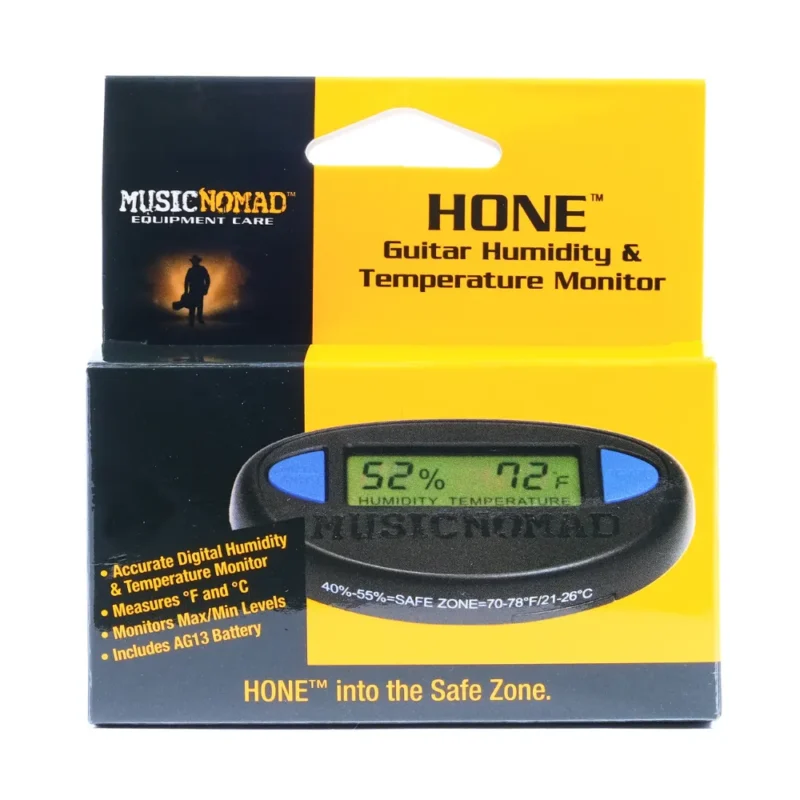
HONE – Guitar Hygrometer – Humidity & Temperature Monitor
MN312$19.99Rated 5.00 out of 5(1)
Does a solid wood guitar need more care than a laminate (layered) wood guitar?
The short answer is yes. Solid wood instruments, often found in premium guitars, are significantly more reactive to temperature and humidity changes than their laminate guitars.
- Solid wood: Solid tonewood is “alive” and highly porous. It absorbs and releases moisture rapidly, making it much more prone to swelling, shrinking, and cracking. Because there are no glue layers to restrict movement, the wood is free to expand and contract with the environment, which can quickly ruin your setup.
- Laminate: Laminate (or layered) guitars consist of three or more layers of wood glued together with the grain running in different directions. This cross-grain construction acts as a structural stabilizer, making the body much more resistant to humidity-related movement.
However, don’t let a laminate body give you a false sense of security. Even if your guitar has laminate back and sides, it most likely has a solid wood neck and fingerboard. These critical components are still susceptible to twisting, bowing, and fret sprout. Whether your guitar is a vintage heirloom or a budget-friendly campfire guitar, maintaining the Safe Zone is essential for protecting the parts of the instrument that affect playability the most.
What causes humidity to change so drastically inside my home?
Your home environment is constantly shifting due to outside weather, your HVAC system, and even the room’s location. Understanding these “Humidity Killers” is the first step to protecting your gear.
- Seasonal changes: Cold winter air is naturally dry, while warm summer air often carries excessive moisture. These swings are why your guitar might play perfectly in July but buzz in January.
- The heater: In the winter, furnaces blast hot, dry air throughout your home. This heated air acts as a powerful dehumidifier and can cause the relative humidity to drop below 20% in an hour or less.
- The air conditioner: AC units don’t just cool the air; they remove moisture like a dehumidifier. In fact, they pull so much water out of the air that they require a dedicated drain line. During a hot summer, your AC can drop the relative humidity to dangerous levels just as quickly as a heater.
- Geography: Your baseline humidity depends on the region you live in. Living in a desert or high-altitude environment means consistent low humidity. Conversely, living in the tropics or near the coast brings a constant threat of high humidity.
- Room location: Where you store your gear matters. Basements and lower levels typically have higher humidity, while attics and upstairs rooms tend to be much drier.
- Exterior vs interior walls: Exterior facing walls are subject to wider temperature swings from the sun and wind. For maximum stability, try to store your guitars against an interior wall. This provides a buffer against the elements and ensures a more constant temperature.
Section Two: Symptoms of Humidity Damage
What are the physical warning signs that my guitar is too dry?
- “Sunken” or concave top: On acoustic guitars, the area behind the bridge looks flat or dipped. This can lead to uncomfortably low action and buzzing.
- Bridge tilt: On acoustic guitars, the bridge is starting to tilt forward toward the soundhole.
- Cracks appearing: Cracks commonly show up on the top, back, or sides.
- Extremely low action: On acoustic and electric guitars neck movement can cause the strings to lay against the frets.
- Fret sprout: On all guitars, fret ends that feel sharp or “poke out” the sides of the fingerboard called fret sprout. For more on fret sprout and how it fix it, see our complete guide.
How can I tell if my guitar is over-humidified (too wet)?
- “Swollen” or bloated top: On acoustic guitars, the soundboard begins to bulge or “belly” behind the bridge. This expansion pushes the bridge upward, significantly altering the geometry of the instrument.
- High action: On acoustic and electric guitars, wood expansion—especially in the neck and top—causes the strings to sit much higher off the fretboard. This makes the guitar feel “stiff” and difficult to play.
- Dull or “muddy” tone: The excess moisture adds weight and mass to the wood, dampening its ability to vibrate. You’ll notice the guitar loses its “sparkle” and resonance, sounding flat or “thuddy.”
- Finish clouding or “blushing”: On guitars with certain finishes (like nitrocellulose), moisture trapped underneath can create a milky, cloudy appearance known as blushing.
- Joint separation or mold: In extreme cases, high humidity can soften glues, leading to bridge lift or loose internal braces. You may also see dark spots or mold growth inside the soundhole.
Is fret sprout caused by humidity?
Yes, when a fretboard dries out, the fretboard wood shrinks. However, the metal frets do not and this causes the frets to protrude past the edge of the wood, creating sharp “sprouts” that can cut your hand while playing. You can prevent the shrinking by humidifying your guitar case with our Humitar – Instrument Case Humidifier.
-
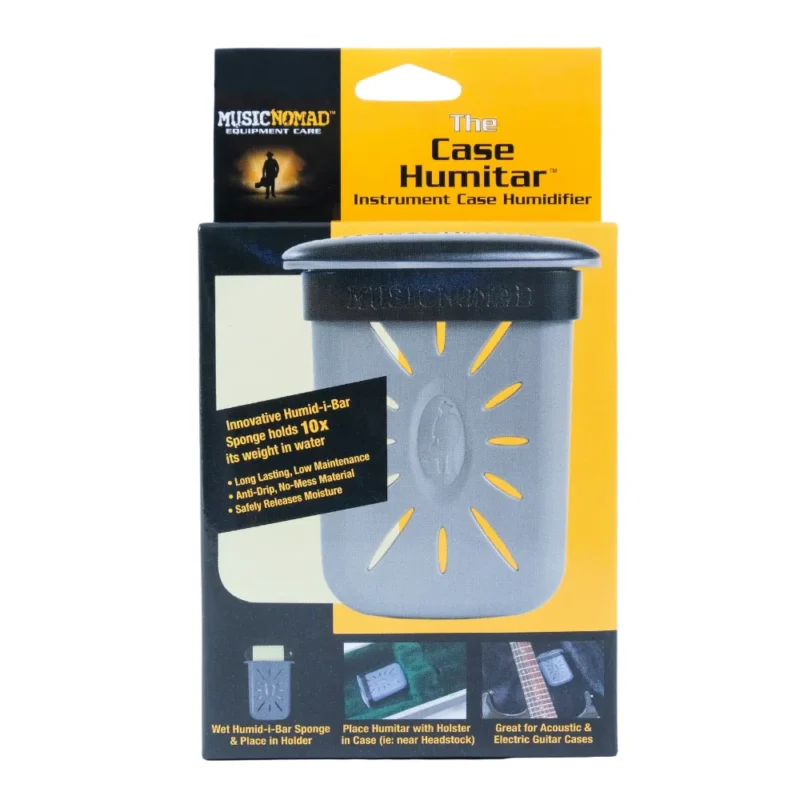
The Humitar – Instrument Case Humidifier
MN303$16.99
Why is my guitar suddenly buzzing even though I haven't changed my playing style?
- Acoustic guitars: As an acoustic guitar dries out for too little moisture, the wood shrinks and the top drops. This lowers the bridge, which brings the strings closer to the frets, causing “humidity buzz.”
- Electric guitars: On electric and acoustic guitars low humidity can not only cause fret sprout, it can also cause frets to pop up, causing them to become uneven and buzz. To find and fix other buzzes, check out The Complete Guide To Fixing Guitar And Bass Fret Buzz.
- Neck movement: changes in humidity can also add relief or back bow to a neck. For more information and how to adjust your neck, see The Complete Guide To Guitar Neck Relief.
Why does the action (string height) of my guitar keep changing with the seasons?
In dry winters, the wood shrinks which can cause buzzing. In humid summers, the wood swells and expands and the action rises, making the guitar harder to play. Luckily, seasonal changes in action can be easily adjusted with just a few simple tools. Check out the The Complete Guide To String Action Height For Electric, Acoustic, Bass and Classical Guitars to learn how to make these seasonal adjustments to your guitar.
Can humidity cause my acoustic bridge to lift, pop off, or crack the wood around it?
Yes. Extreme low humidity and dryness creates tension that can dry out and snap the glue bond between the bridge and the top. Conversely, high humidity can cause a swollen top to “belly” or bulge so much that the bridge will lose connection with the top and the glue joint will fail.
How does humidity affect my guitar's tuning stability and neck relief?
The neck is the most sensitive part of the guitar. In low humidity necks typically backbow, causing buzzing all over the fretboard. In high humidity the neck upbows (concave) or adds relief, causing higher action. Keeping your humidity stable will help keep your action and playability consistent, leading to more stable tuning and intonation. Check out the The Complete Guide To String Action Height For Electric, Acoustic, Bass and Classical Guitars to diagnose and fix changes in your guitar’s action.
How long does it take for a guitar to crack?
When humidity changes, you’ll be able to feel your guitar change in just a few hours. Constant low humidity can cause a crack in just a few weeks. In extreme conditions, humidity of 15% or less, a guitar can develop a crack in as little as 24–48 hours. That’s why consistently regulated humidity is extremely important year round.
Section Three: Using A Hygrometer
Why should I use a hygrometer?
A digital hygrometer is the most important tool in your maintenance kit because it gives you the power to be proactive. It provides a precise reading of the environment, giving you the chance to take action before expensive, permanent damage occurs.
- Digital vs. analog: While analog hygrometers are available, they are often slow to react to environmental shifts and typically have a wide range of inaccuracy.
- Real-time accuracy: Digital sensors are far more sensitive to the rapid changes caused by a heater or AC unit kicking on. The MusicNomad Hone updates its readings every 20 seconds, providing you with up-to-the-minute accuracy so you can monitor your Safe Zone with confidence.
Should I have more than one hygrometer?
Yes. One of the biggest misconceptions in guitar care is that the humidity in the center of your room is the same as the humidity inside your guitar case. Every room contains multiple micro-climates that can vary drastically based on airflow and heat sources.
It’s good practice to have multiple hygrometers in the room where you store your guitars, and in the soundhole of acoustics, and in the cases you store electric guitars. Each case has its own unique micro-climate and needs to be monitored to protect your instruments from harm.
- Room Level: Storing your guitars near windows, exterior walls, or HVAC vents will cause significant swings in temperature and relative humidity compared to the rest of the room. Having a hygrometer where you store your guitars will help you monitor the overall moisture in the room.
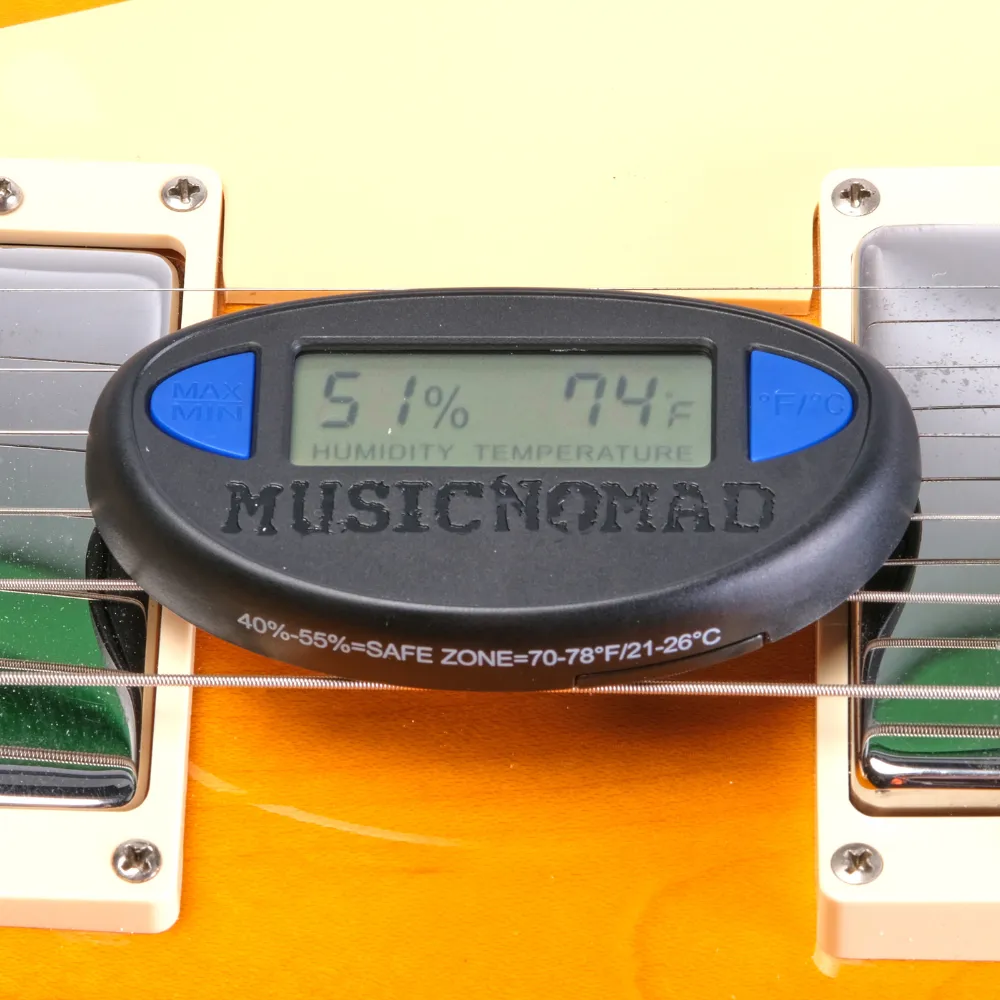
- Case Level: Each guitar case has its own unique micro-climate. An electric guitar stored in a hardshell case creates a different environment than one on a wall hanger. For electrics and basses, we recommend a dedicated hygrometer like the MusicNomad Hone. It clips to the strings or spare space in the case, making it easy to monitor the health of the guitar.
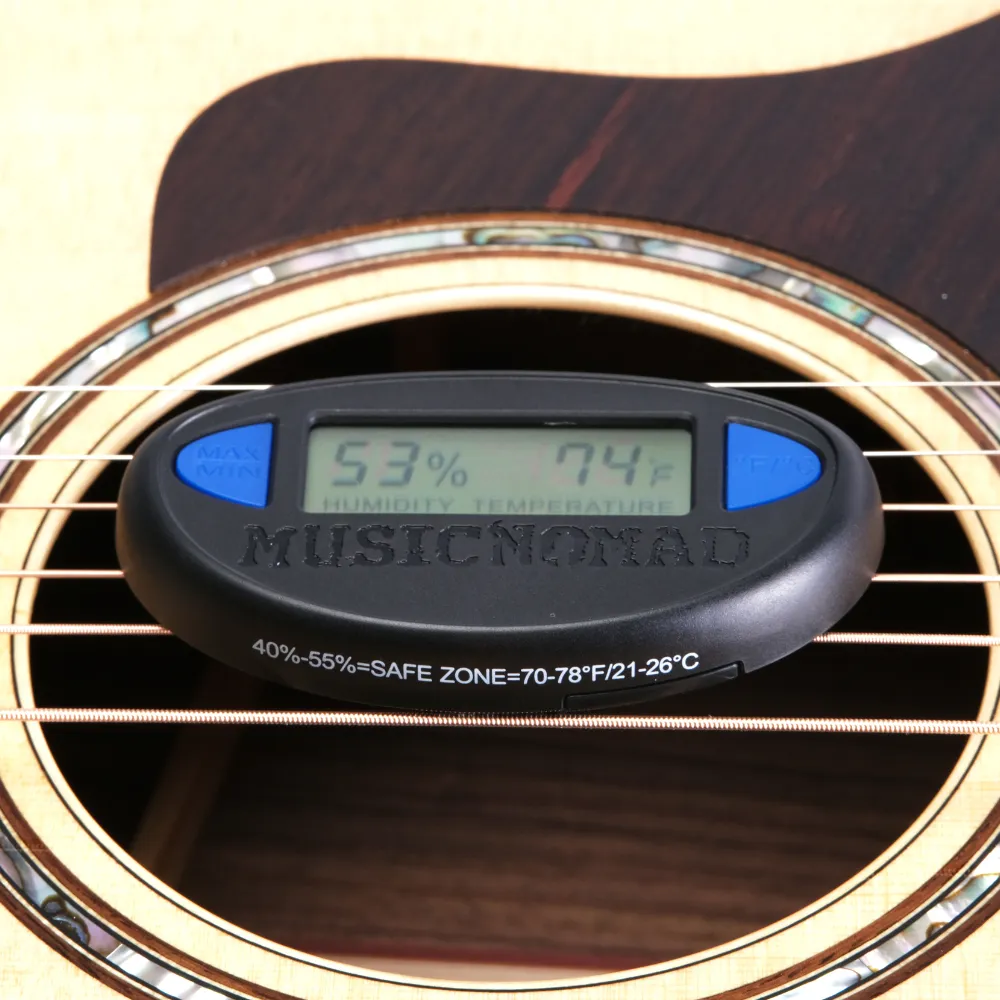
- Soundhole Level: For acoustic guitars, the most critical micro-climate is inside the body. Having a hygrometer in the soundhole, like the MusicNomad Hone, provides the most accurate reading of the wood’s actual environment. The Hone also shows you the minimum and maximum temperature and humidity it has measured, letting you know of changes when you might not be seeing throughout the day.
To simplify your entire set up, using a hygrometer and a humidifier together will ensure you are monitoring and protecting your instrument at the same time. The Humitar ONE combines both for an incredibly easy and efficient way to monitor and regulate your guitar’s humidity.
Should I measure the humidity of the whole room or just inside the guitar or guitar case?
Inside the guitar or case is the most accurate. The micro-climate inside your guitar or case is what your guitar is actually experiencing. A room hygrometer might say 45%, but the inside of a dry wooden case could be 30%.
While cases offer more protection, old wooden cases can actually pull moisture out of your guitar that is stored inside. That’s why it’s important to monitor and humidify the case, which is easy with the Humitar ONE.
A room hygrometer serves as an essential monitor for the entire space, providing a general reading of your environment so you know exactly when to deploy a whole-room humidifier or dehumidifier.
I already humidify my guitar, so why do I need a hygrometer?
Humidifying without a hygrometer is like driving a car without a fuel gauge; you’re simply guessing how much is left in the tank. Without a precise reading, it’s easy to over-humidify or under-humidify your instrument, both of which lead to costly repairs.
- The Danger of Over-Humidifying: Not all guitars absorb moisture at the same rate. If your guitar is already stable, leaving a saturated sponge in the case can push the humidity levels well past the Safe Zone, causing the wood to swell, glue joints to soften, and the top to “belly.”
- The “Thirsty” Guitar: Conversely, a severely dry guitar will need moisture much faster than you might realize. A standard humidifier sponge can dry out in a matter of days before the wood has even reached equilibrium, leaving your guitar vulnerable to damage once again.
Monitoring the soundhole or case (like with the MusicNomad Hone) is the only way to know exactly what your guitar needs.
How do I use a hygrometer inside my guitar or case?
Unlike other hygrometers, the MusicNomad Hone is designed to be used on the guitar or in the case. Just clip it directly to the strings on the neck or inside the soundhole or sit it inside the case. This gives you a reading from the most critical area, the body of the instrument.
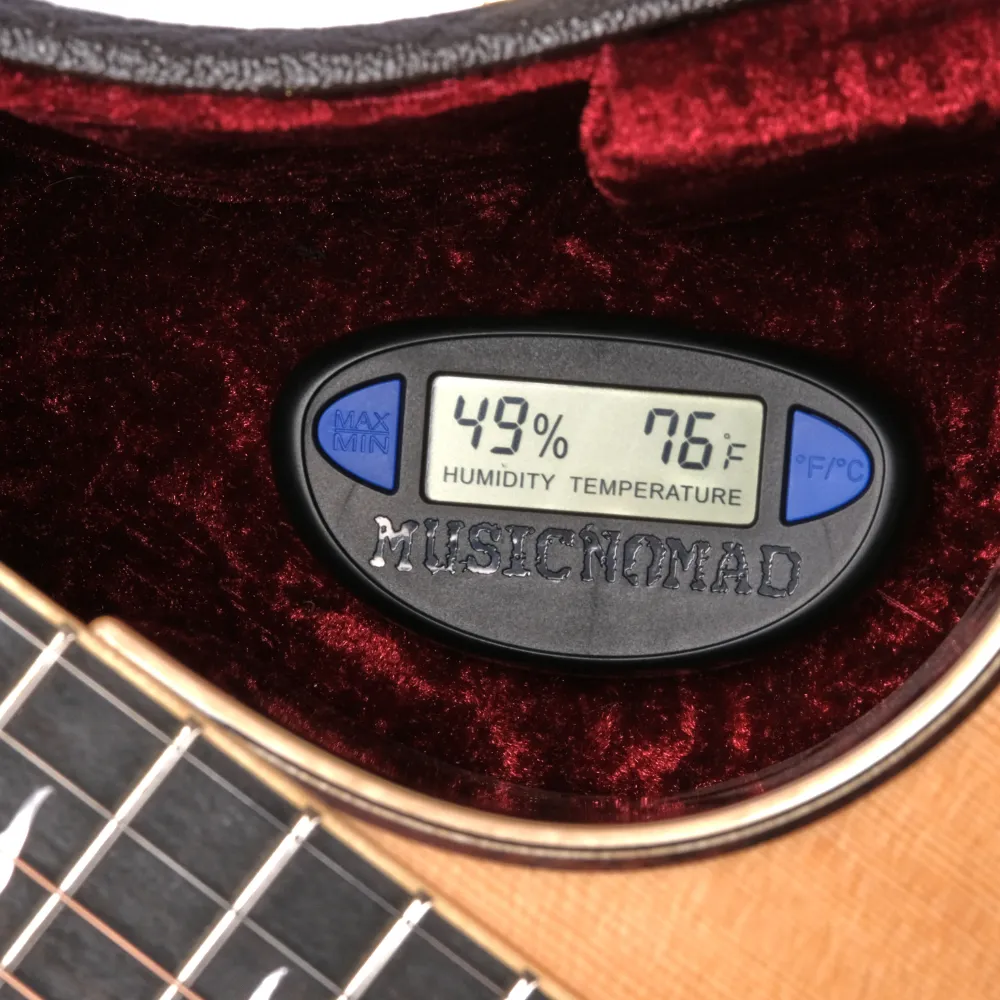
I use two-way humidification packs. Do I still need a hygrometer?
Yes. Two-way humidification packs can help regulate humidity, but they have several drawbacks. They are slow to release and absorb moisture, and may not reach the Safe Zone quickly enough to protect your guitar from damage. Having a hygrometer like the MusicNomad Hone will take out all of the guesswork and let you know what your guitar needs
Two-Way Humidity Packs can also leak and do serious damage to your guitar. The Humitar has a special sponge that is anti-drip and much safer than the gel in two-way humidification or other sponges. Additionally, two-way humidification has a limited lifespan and will need to be replaced, which can be costly. The sponge in The Humitar and Humitar ONE is reusable and can last years.
How often should I be checking my hygrometer readings?
During seasonal shifts (Fall/Spring), check daily. Once the climate stabilizes, a quick check every few days or every time you open the case to practice is sufficient. If you have a room hygrometer and notice changes, it’s good practice to check inside the case.
During seasonal change is the most critical time as temperature changes and heaters/air conditioners are used more. The MusicNomad Hone checks every 20 seconds for extreme accuracy, letting you know how the seasonal change is affecting your instrument.
Section Four: Choosing The Right Humidifier
How often should I be checking my hygrometer readings?
- Soundhole humidifier: (like The Humitar) it releases moisture directly into the body of the acoustic guitar through the soundhole, protecting the most vulnerable joints and braces.
- Case humidifier: (like the Humitar – Instrument Case Humidifier) treats the entire environment inside the case, including the neck and fretboard. This is ideal for electric instruments to prevent fret sprout or for acoustic instruments with F-holes. For acoustic guitars in very dry climates, both a case and soundhole humidifier can be used together if needed.
How does a soundhole humidifier actually work?
A soundhole humidifier works through a simple process of evaporation. Because wood is hygroscopic, it acts like a magnet for moisture. Most soundhole humidifiers use a sponge soaked in water, as the dry air inside the guitar circulates, it pulls moisture from the sponge suspended in the soundhole, safely hydrating the wood. They are suspended by the string or attached to the soundhole and hang into the body of the guitar.
The Humitar uses a special sponge that holds 10x its weight in water and won’t drip into your guitar like regular sponges can. This also makes it less prone to drying out, protecting your guitar longer. It also only contacts the strings and does not risk scratching the guitar’s finish.
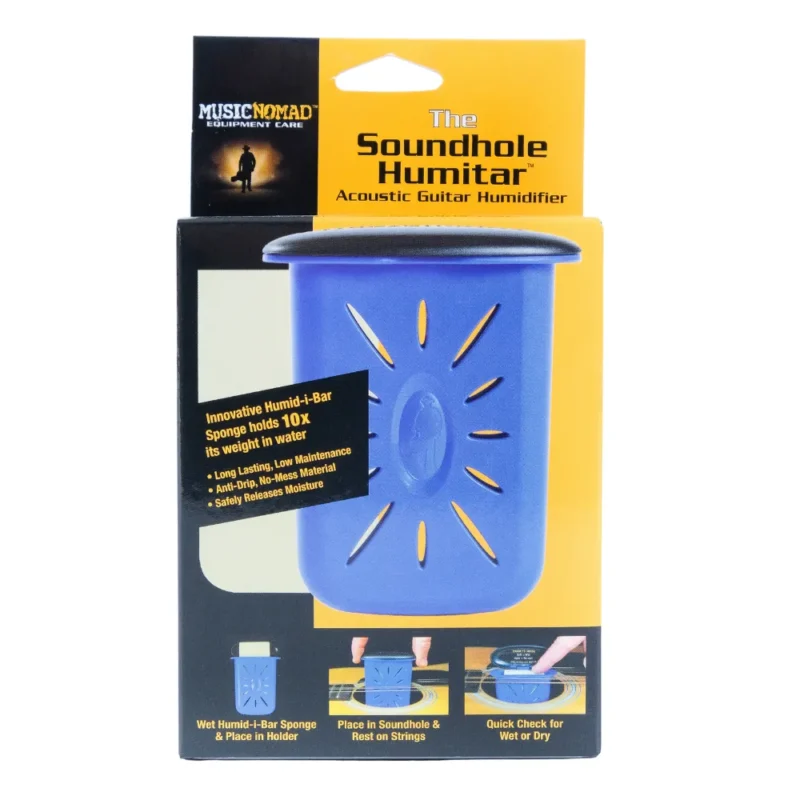
The Humitar uses a special sponge that holds 10x its weight in water and won’t drip into your guitar like regular sponges can. This also makes it less prone to drying out, protecting your guitar longer. It also only contacts the strings and does not risk scratching the guitar’s finish.
Why do acoustic guitars need a soundhole humidifier?
Acoustic guitars are made of thin pieces of wood which are much more affected by humidity changes. These woods also absorb and lose moisture more quickly and expand and contract more readily than the thicker woods of electric guitars. The inside of acoustic guitars is usually unfinished, which leaves the wood more prone to moisture changes. That’s why it is essential to constantly monitor and regulate their relative humidity.
Do I need to humidify my electric guitars?
Yes. While electric guitars are less prone to major humidity-related damage than acoustic guitars, they are still prone to neck warping, fret sprout, cracked fingerboards, and finish checking. Keeping the case humidified (the Humitar – Instrument Case Humidifier is perfect for this) will help prevent damage and keep the guitar playing and sounding great.
When should I use a humidifier versus a dehumidifier?
- If your hygrometer reads below 40%, you need to add moisture with a humidifier.
- If your hygrometer reads above 55%, you need to remove moisture by dehumidifying the room. It’s not recommended to try and dehumidify an individual guitar, as it is very easy to damage the instrument if you remove too much moisture too fast.
Why is a hardshell case better for humidity control than a gig bag or a wall hanger?
A hardshell case creates a sealed environment or micro-climate. A gig bag is porous and “leaks” moisture, while a wall hanger leaves the guitar at the mercy of your home’s HVAC system. While cases offer more protection, old wooden cases can actually pull moisture out of your guitar that is stored inside. That’s why it’s important to monitor and humidify the case at the same time, which is easy with the Humitar ONE.
Do I need a hygrometer and a humidifier?
Yes. For both convenience and accuracy, with both you know when your instrument is at the optimal conditions, and when it needs additional care. The Humitar ONE combines a high-quality humidifier with a precision digital hygrometer. It allows you to humidify and monitor simultaneously.
Do I need a special humidifier for smaller stringed instruments like Ukuleles?
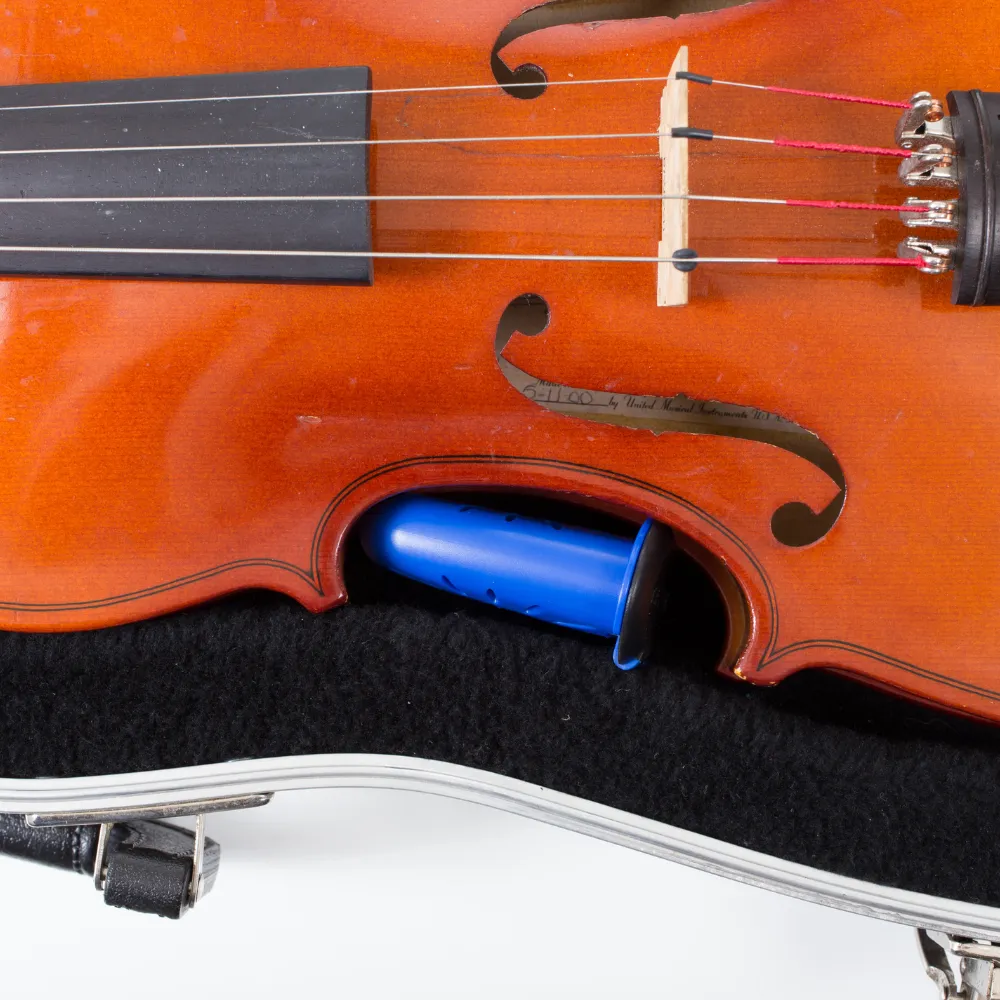
Yes. Standard humidifiers are often too large for ukulele soundholes. Using a dedicated tool like The Humilele ensures a proper fit and the right amount of moisture for a smaller body. The Humilele also fits in all Soprano, Concert, Tenor Baritone Ukulele soundholes. The Humilele is also perfect to put the small instrument cases like mandolins and violins to help protect these instruments as well.
-
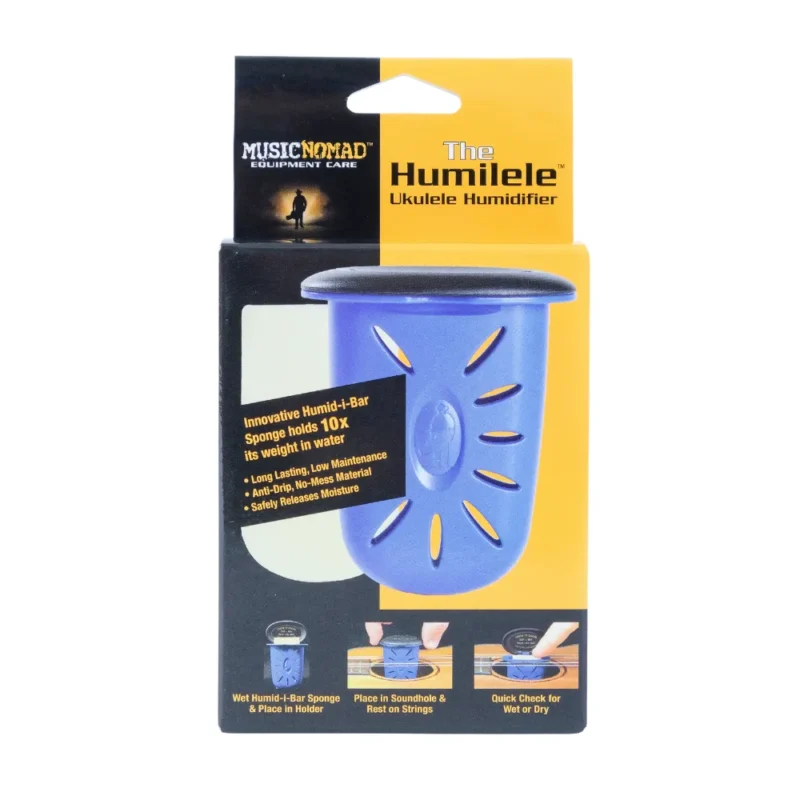
The Humilele – Ukulele Humidifier
MN302$9.99
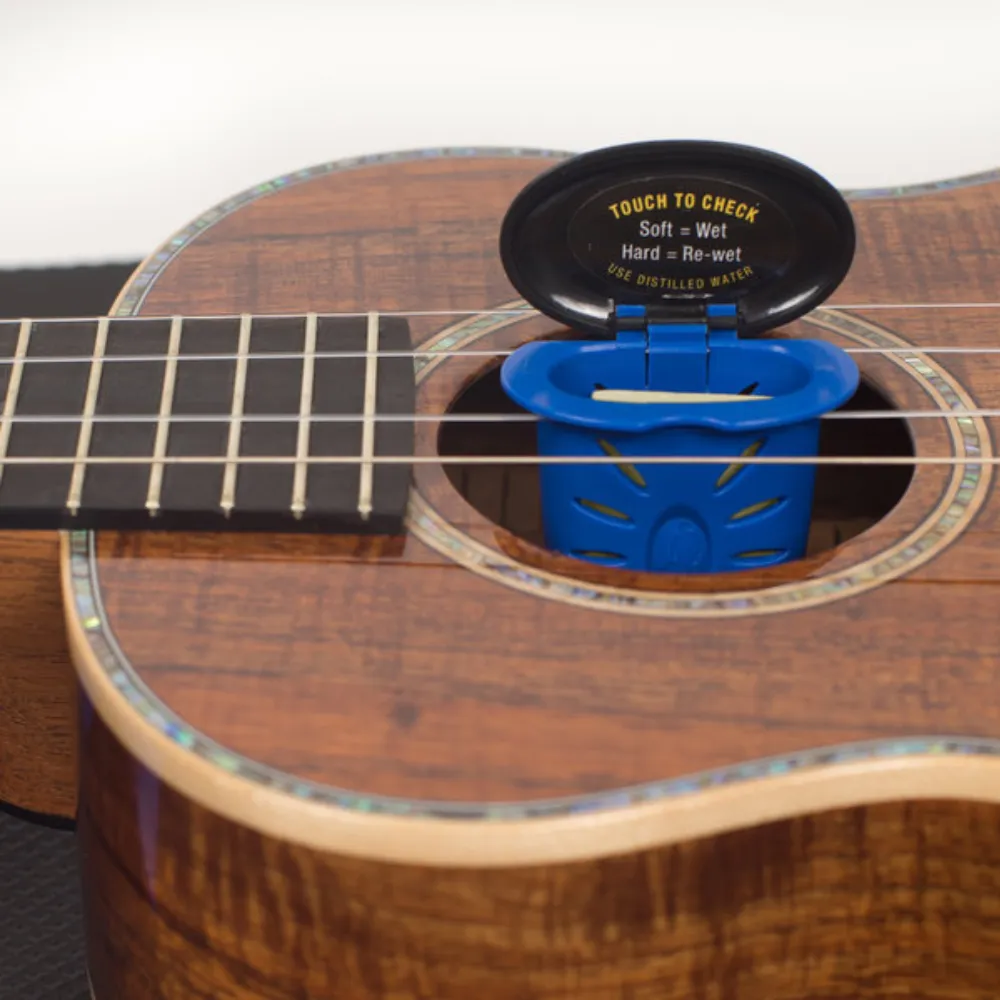
between strings
Section Five: Keeping Your Instruments Healthy Year-Round
How should I store my guitar for maximum humidity protection?
For the most effective protection, store your guitar inside its hardshell case. Think of a case as a protective micro-climate. When you use a humidifier like The Humitar or Humitar ONE inside a closed case, you are humidifying the guitar and its immediate environment directly, rather than fighting the air in the entire room. This makes the process faster, more efficient, and significantly easier to regulate.
Can I humidify my guitar on a wall hanger or stand?
Yes, although keeping it in the case will keep the humidity level more stable. Unlike many traditional humidifiers that are prone to leaking, The Humitar or Humitar ONE are designed to be held securely by the string tension. This allows you to humidify your instrument in any orientation—whether it’s sitting on a floor stand or hanging on the wall.
Because our Humid-i-Bar Sponge is a specialized anti-drip material, you don’t have to worry about water leaking into the body or down the finish while the guitar is vertical. However, keep in mind that an open room is a much more variable environment than a case.
If you do humidify your guitar outside of a case, here are a few things to remember:
- Faster Evaporation: In an open room, the moisture from the sponge will be pulled into the surrounding dry air much faster than in a sealed case. You’ll need to check and re-wet your sponge more frequently to keep the wood from drying out.
- Hygrometer Accuracy: A hygrometer is most effective in small, controlled spaces. When your guitar is on a wall, a room hygrometer tells you the moisture of the room, but it may not accurately reflect the moisture level of the guitar itself.
- Drafts and Vents: If you store your guitar out in the open, ensure it is away from direct sunlight, exterior-facing walls, and humidity-stealing heating/AC vents, as these create rapid temperature swings that can crack your finish or worse.
Ultimately, the Safe Zone is easiest to maintain inside a latched case lid. Whether you prefer your guitars on the wall for easy access or tucked away in a case, consistent monitoring with a digital hygrometer and a quality humidifier is the only way to ensure your tonewoods stay healthy and your setup stays perfect.
Can I use tap water in my humidifier sponge, or should I use distilled water?
We recommend using distilled water. Tap water contains minerals and chlorine that can discolor the sponge. If you are using a room humidifier, it’s worth buying distilled water to minimize fluorides and particulates that are in city water. If you have many guitars and live in a dry climate, a small water distiller is a good purchase to keep your humidifiers working best.
How often do I need to re-wet the sponge in my humidifier like the Humitar or Humilele?
When you see the relative humidity dropping on your hygrometer, check every 2-3 days. If the sponge feels soft, it’s still providing moisture. If it is firm or hard, it’s time to re-wet it. The Humid-i-Bar Sponge in the The Humitar holds 10x its weight in water and is less prone to drying out, protecting your guitar longer. Regular sponges in other humidifiers dry out much faster and need to be checked more often.
How can I tell when it's time to replace my humidifier sponge?
If the sponge no longer softens when soaked, develops a smell, or shows signs of mineral buildup, it’s time to replace the sponge. The Humid-i-Bar Sponge has a special closed-cell design that holds water longer and needs to be replaced less often.
What is the "24-hour rule" when bringing a guitar into a new environment?
When shipping a guitar or bringing it in from a cold or hot car, leave it in the closed case for 24 hours. Rapid temperature/humidity changes cause “finish checking” or cracking in the lacquer. You want to wait until the temperature inside the case matches the temperature in the room where you will store the guitar.
Is it possible to "over-humidify" my guitar by leaving the humidifier in too long?
Yes. If the environment is already at 55% RH and you continue to add moisture, the wood can swell. Always use a hygrometer like the MusicNomad Hone or Humitar ONE to know when to pull the humidifier out.
If my guitar already has a crack, is it too late to start using a humidifier?
It is never too late. Humidifying a cracked guitar can often “close” the crack, making the eventual repair by a luthier much easier and more successful. Leaving it without humidity can cause a crack to worsen and spread.
Section Six: Common Misconceptions
My guitar is a 'beater,' does it still need a humidifier?
Yes. A “beater” that is unplayable due to a warped neck or sharp frets isn’t fun to play. Basic humidity care keeps even the cheapest guitars playing great.
I live in a humid climate, so I never have to worry about my guitar drying out, right?
Wrong. If you run the air conditioning in the summer or the heater in the winter, you are creating a dry environment inside your home regardless of the weather outside. Every player should monitor their humidity.
Does leaving a bowl of water in the room provide enough moisture for my guitar?
No. You would need to evaporate gallons of water with a room humidifier to change the relative humidity of a whole room significantly. Targeted case and soundhole humidification is the most effective. A room humidifier can help maintain the space you keep your guitars in and minimize large swings in humidity.
Can I just leave a damp kitchen sponge in my case?
Kitchen sponges drip, quickly mold, and dry out too fast. Our Humid-i-Bar Sponge is anti-drip and designed for slow, consistent release, and the special material resists mold like open cell kitchen sponges can.
Is a guitar case naturally humidified, or do I need to add something to it?
Cases can actually steal moisture from the guitar stored inside. Most cases are made of wood and fabric that will absorb moisture from your guitar unless you provide a dedicated moisture source like The Humitar.